
AI Is Not the Strategy: Why Businesses Need a Commercial Use Case Before Investing
Category:
Strategy & Transformation
Technology, Data & AI
Written by: BDR Research & Analysis Team 15/06/2026
Why businesses need a clear commercial use case before investing.
AI adoption should begin with a business problem, not a technology decision. For owners, boards and leadership teams, the priority is to identify where AI can improve performance, support decision-making and create measurable operational value.
Artificial intelligence has moved quickly from boardroom discussion to operational priority. Across sectors, businesses are exploring how AI can improve productivity, decision-making, reporting and customer service.
Adoption is accelerating. McKinsey reported that 78% of organisations were using AI in at least one business function in 2024, while Stanford’s 2025 AI Index reported that private investment in generative AI reached $33.9 billion in 2024.
But adoption does not always translate into value.
For owners, boards and leadership teams, the key question is not whether the business should “do AI”. It is where AI can solve a real commercial problem, improve performance or strengthen the way the business operates.
AI is not a strategy in itself. It is a tool. Its value depends on the quality of the use case, the readiness of the organisation and the discipline with which it is governed and measured.
Key developments
AI is moving from experimentation to execution
Many businesses have already tested AI in areas such as reporting, content, customer support, data analysis and workflow automation. The next phase is more demanding: deciding which use cases should be scaled, paused or stopped.
The commercial case matters more than the technology
A tool may be impressive, but if it does not improve a process, reduce friction, support a decision or enhance the customer experience, its impact will be limited. A strong use case starts with a clear business problem and a measurable outcome.
Data and process quality are becoming critical
AI depends on the information and processes behind it. Fragmented systems, inconsistent reporting and unclear accountability can limit adoption and reduce value. For many businesses, better data, reporting and process discipline are the real starting points.
Governance cannot be left until later
Boards and leadership teams need to know where AI is being used, what decisions it supports, what risks it introduces and who remains accountable. Governance should cover decision rights, data usage, oversight, reporting and controls.
Value will come from integration, not isolated pilots
Pilots can be useful, but lasting value comes when AI is connected to core processes, management information, customer journeys and operating models. Not every idea deserves investment.
Questions leadership teams should ask
Before committing further time or resources, leadership teams should consider:
- What business problem are we trying to solve?
- Why does it matter commercially?
- What process, decision or customer journey will change?
- How will success be measured?
- Do we have the data and process discipline required?
- Who owns AI decision-making and governance?
- Which use cases should be scaled, paused or stopped?
- How would we explain our approach to shareholders, lenders, buyers or other stakeholders?
These questions help move the discussion from technology interest to commercial discipline.
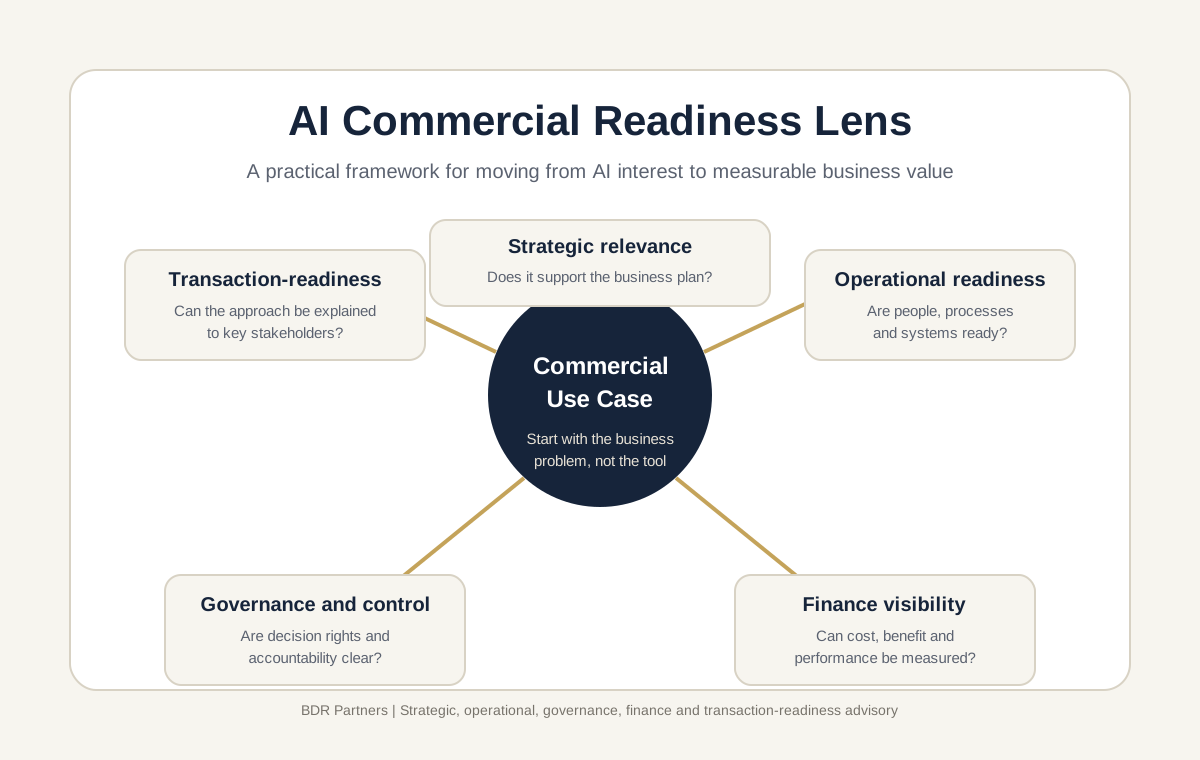
A practical readiness lens
BDR Partners views AI readiness through five practical lenses:
Strategic relevance — does the use case support the business strategy, customer proposition or competitive position?
Operational readiness — are the people, processes, systems and accountability in place to make it work?
Finance visibility — can management track cost, benefit, productivity impact and performance improvement?
Governance and control — is it clear where AI is used, who is accountable and how outputs are reviewed?
Transaction-readiness — can the business explain how AI supports performance, resilience and future value creation?
What businesses should do now
Businesses should start with the commercial problem, not the tool. The most useful AI opportunities usually sit where there is a clear source of friction, cost, delay, inconsistency or missed insight.
Leadership teams should prioritise use cases based on commercial relevance, ease of delivery, data readiness, operational impact and governance requirements. They should also strengthen the foundations: better data, clearer reporting, improved processes and defined accountability.
Success should be measured through business outcomes, not activity. Relevant measures may include time saved, cost reduction, improved reporting, faster response times, better forecasting or reduced operational risk.
How BDR Partners can help
BDR Partners supports owners, boards, leadership teams and finance leaders with strategic, operational, governance, finance transformation and transaction-readiness advisory.
We help clients bring structure to AI-related decisions by focusing on the commercial questions first.
Our support may include:
Commercial use case assessment
Identifying where AI may create practical business value and prioritising opportunities based on strategic relevance, feasibility and measurable impact.
Operating model and process review
Reviewing the processes, systems, reporting structures and accountability needed to support effective adoption.
Finance and performance visibility
Helping finance leaders consider how AI-related initiatives should be tracked, measured and reported.
Governance support
Supporting boards and leadership teams with practical governance around decision rights, oversight, accountability and risk considerations.
Transformation and transaction-readiness support
Helping businesses translate AI ambition into a practical roadmap and ensure initiatives are clearly understood, documented and connected to the wider value creation plan.
Expert view
“AI should not be treated as a strategy in itself. The real question for owners, boards and leadership teams is where it can solve a meaningful business problem, improve performance and support long-term value creation. That requires commercial discipline, operational readiness and clear governance.”
BDR Research & Analysis Team
Conclusion
AI will continue to change how businesses operate and compete. But the organisations that benefit most will not be those that adopt the most tools. They will be those that understand where technology supports the commercial priorities of the business.
For owners, boards and leadership teams, the starting point should be clear: define the business problem, assess the use case, strengthen the foundations and measure the impact.
AI is not the strategy. It is one part of how a well-prepared business may deliver it.
Discuss your priorities with BDR Partners
BDR Partners works with family-owned businesses, entrepreneurs, shareholders, family offices, private investors, boards, leadership teams and CFOs to support strategic planning, operational improvement, governance, finance transformation and transaction-readiness.
To discuss how AI, data and technology change may affect your business strategy, performance and readiness, please contact BDR Partners.
Disclaimer
BDR Partners provides strategic, operational, governance, finance, transformation and transaction-readiness advisory services only. BDR Partners does not provide regulated investment advice, investment management, portfolio management, capital raising, investment arrangement, debt placement, financing arrangement or investment product services